2025
Future urban trees
2025
Future urban trees
Cities are warming, densifying, and facing increasingly extreme weather. At the same time, many urban trees fail to reach maturity. This creates a fundamental contradiction: cities urgently need the multidimensional ecological services of large, mature trees, yet current urban conditions rarely allow trees to grow old. Bureau B+B was commissioned by the College van Rijksbouwmeester en Rijksadviseurs (CRa) to investigate how urban landscapes can be designed to support trees in reaching maturity and growing old. The research included expert interviews and reflection on long-term design practice.
Client
College van Rijksbouwmeester en Rijksadviseurs (CRa)
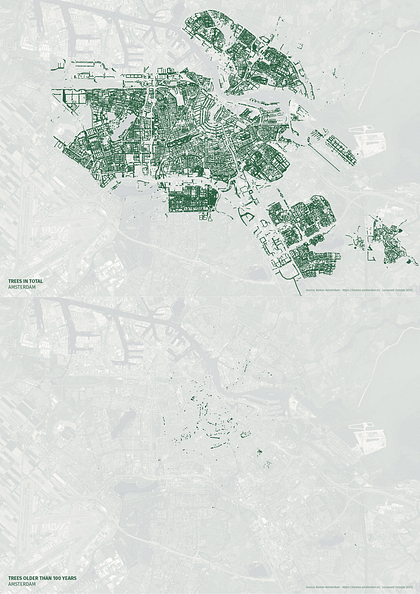
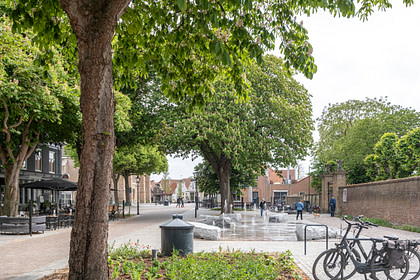
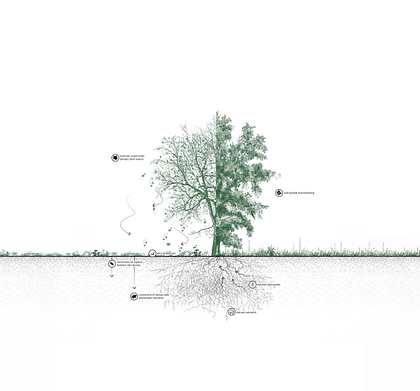
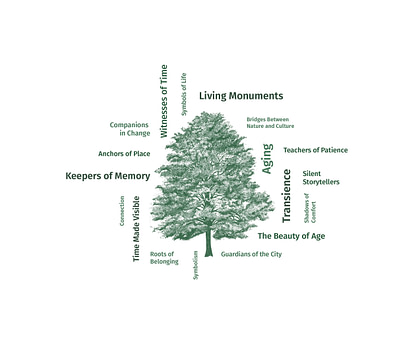
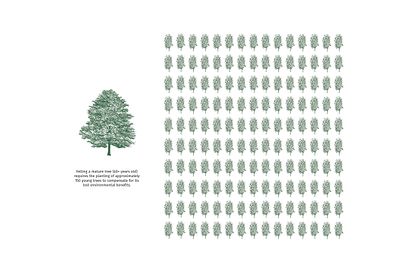
Witnesses of time, companions in change, symbols of life cycles – trees bear deep social and environmental meaning. There is no single definition of an “old” tree: the age at which a tree is considered old varies by species and context. Old trees are best understood by their structural and ecological characteristics — thick bark, cavities, deadwood, large crowns, complex branching, and extensive underground root systems supported by mycorrhizal networks. These features create habitats and support urban biodiversity in ways that young trees simply cannot. Their large crowns offer deep shade, cool streets, and regulate microclimates, while their extensive root systems stabilize soil and absorb large volumes of water. When an old tree is lost, it takes many years for new trees to compensate for it. Beyond these environmental functions, they act as living landmarks, shaping place identity and connecting past, present, and future.
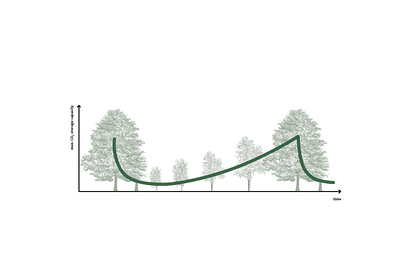
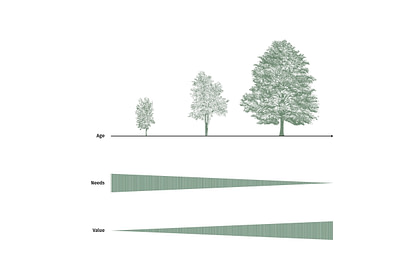
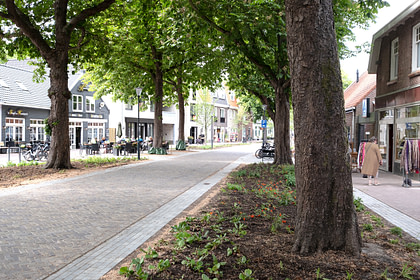
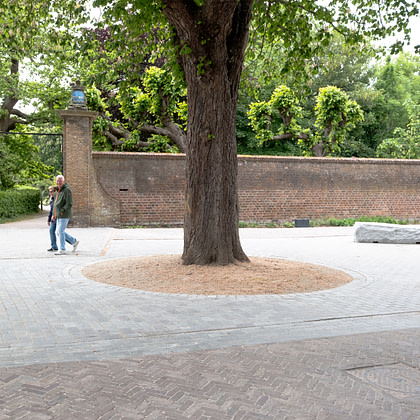
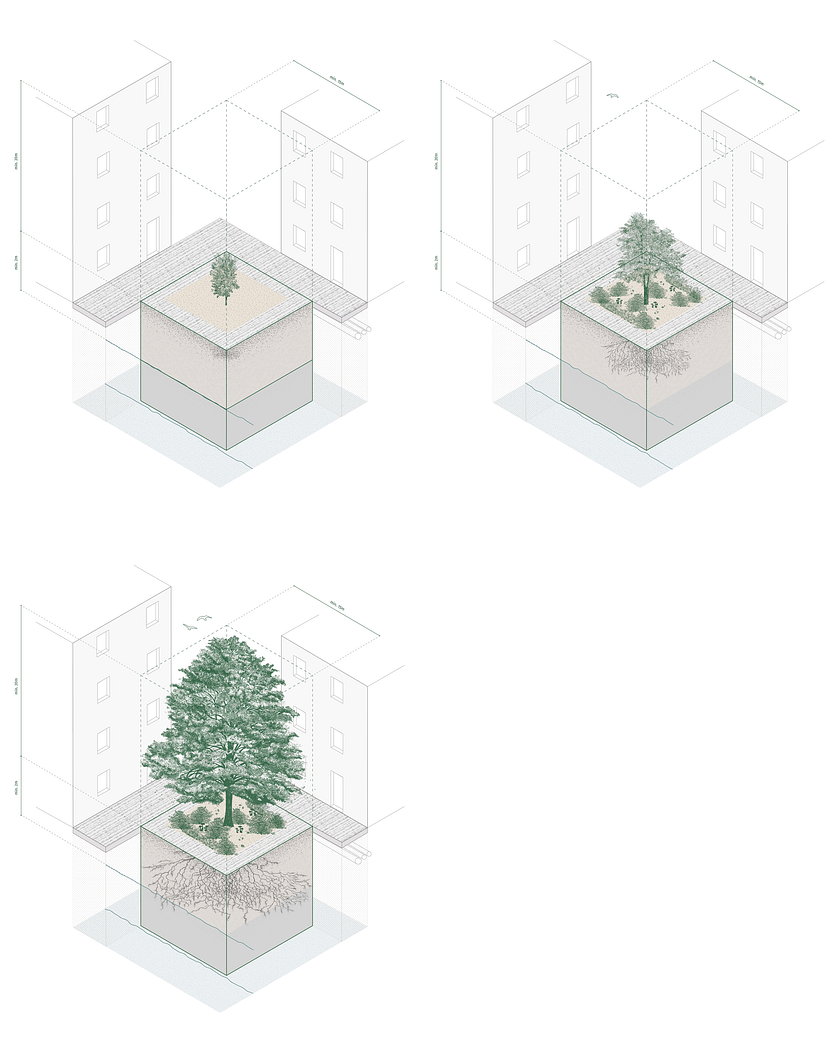
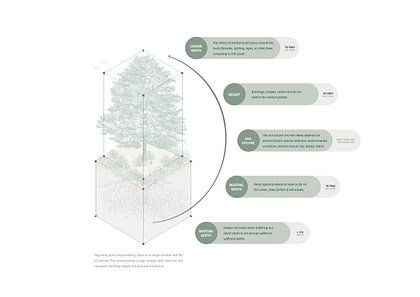
Designing for old trees therefore requires both spatial and procedural change. Trees only grow old if cities reserve enough space for their future size from day one. Equally important are choosing suitable species, selecting the right locations, and providing support that allows trees to become self-sustaining over time. Future-proof trees also require future-proof soil – deep, oxygen-rich, well-drained, and biologically active.
Ultimately, trees must be embedded early in planning processes, protected across project phases by multiple actors, and supported by long-term stewardship and transparent decision-making. Visual representation plays a key role in securing this future space. Translating time and change into drawings helps communicate long-term intentions, prevent conflicts, and protect growing trees. Only through aligned design and process can cities truly create the conditions for trees to grow old.